
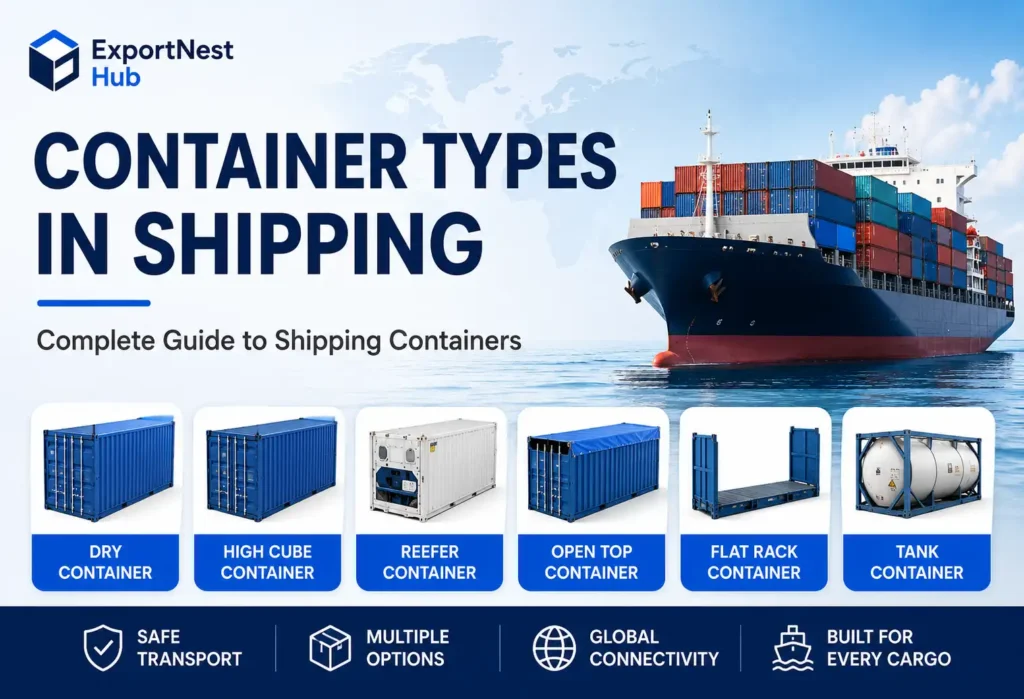
Shipping containers are the backbone of modern international trade. Every day, millions of goods move across oceans, borders, and ports inside metal boxes designed to protect cargo and make transportation efficient. But not every shipment fits into the same kind of box. That is why there are different container types in shipping, each built for a specific cargo need, loading method, temperature requirement, or handling style.
If you are new to logistics, the variety can feel confusing at first. You may hear terms like dry container, reefer container, open top container, or flat rack container and wonder what each one means. In reality, these shipping container types are easy to understand once you know what problem each one solves.
This guide explains the major types of containers in shipping, how they are used, what makes them different, and how to choose the right one for your cargo. Whether you work in export, import, freight forwarding, warehousing, or supply chain planning, understanding container sizes in shipping and container categories is essential.
What Is a Shipping Container?
A shipping container is a standardized cargo unit used to move goods safely and efficiently across transport networks. Most are made of steel or aluminum, designed to be stacked, lifted, locked, and transported by ship, truck, or rail.
The biggest advantage of a shipping container is consistency. Since containers follow standard dimensions, they can be transferred between vessels, trucks, and terminals with minimal handling. This reduces damage, improves speed, and makes cargo movement more predictable.
Shipping containers are not just boxes. They are engineered for different cargo needs. Some are built for general goods, some for temperature-sensitive cargo, and others for oversized or irregular shipments. That is why understanding container types in shipping matters so much.
| Container Type | Best For |
|---|---|
| Dry Container | General cargo |
| High Cube | Bulky cargo |
| Reefer | Temperature-controlled goods |
| Open Top | Tall cargo |
| Flat Rack | Oversized machinery |
| Tank Container | Liquids and gases |
| Ventilated | Moisture-sensitive cargo |
Why Different Container Types Exist
Different cargo needs different handling conditions. A shipment of garments does not require the same setup as a shipment of frozen seafood. A heavy machine may not fit inside a standard closed box. A liquid chemical may need a tank unit rather than a dry box. This is where container specialization becomes important.
Different shipping container types exist because cargo varies by:
- size
- weight
- shape
- temperature requirement
- loading method
- sensitivity to moisture
- fragility
- hazard category
In other words, container variety is not about complexity for its own sake. It is about matching cargo with the right transport environment. The better the match, the safer and more efficient the shipment.
Standard Dry Containers
The standard dry container is the most common type used in shipping. When people say “container” without adding any other description, they are often referring to this one.
A dry container is fully enclosed, weather-resistant, and suitable for general cargo that does not require temperature control or special access. It is used for products such as:
- cartons
- packaged consumer goods
- electronics
- textiles
- furniture
- industrial parts
- machinery components
These containers come in common sizes such as 20-foot and 40-foot units. They are ideal for cargo that can be loaded from the rear and stacked efficiently inside the box.
Dry containers are the foundation of global shipping because they are versatile, easy to handle, and widely available. For most exporters, this is the first container type they will use.
High Cube Containers
A high cube container looks similar to a standard dry container, but it is taller. The extra height gives shippers more vertical space for cargo that is bulky but not necessarily very heavy.
This makes high cube units useful for:
- lightweight but large-volume shipments
- furniture
- cartons with extra stacking height
- plastic goods
- textiles
- packaged products that need more headroom
High cube containers are often chosen when a standard container runs out of height before it runs out of weight capacity. That extra space can make a big difference in load planning and cargo efficiency.
For businesses shipping goods with a lot of volume, the high cube option can reduce the need for multiple containers.
Reefer Containers
A reefer container is a refrigerated container used for temperature-controlled shipments. It is one of the most important container types in shipping for food, pharmaceuticals, flowers, and other perishable goods.
Reefer containers can maintain a specific temperature range throughout the journey. That makes them essential for:
- frozen food
- fresh produce
- meat and seafood
- dairy products
- vaccines
- medicines
- temperature-sensitive chemicals
- floral products
Unlike dry containers, reefer units require power during transit and at terminals. They are more expensive to use because they involve refrigeration systems and monitoring.
However, for cargo that must remain cold or frozen, a reefer container is not optional. It is the only safe choice. For exporters dealing with perishable goods, understanding reefer container operations is critical.
Open Top Containers
An open top container is designed for cargo that cannot easily be loaded through the rear door because of its height or shape. Instead of a fixed roof, it has a removable tarpaulin cover.
This makes open top units ideal for cargo such as:
- tall machinery
- construction equipment
- engine parts
- irregularly shaped goods
- cargo that must be loaded from above using a crane
The open roof gives loading flexibility when side or rear access is not enough. The cargo is often secured and then covered for protection during transport.
Open top containers are widely used in industrial shipping where cranes or overhead lifting equipment are available. They are a practical solution for cargo that does not fit standard enclosed boxes.
Flat Rack Containers
A flat rack container has a base and strong end walls, but no fixed side walls and often no roof. This makes it one of the best options for oversized cargo.
Flat rack units are used for:
- heavy machinery
- vehicles
- large equipment
- steel structures
- construction materials
- cargo wider or taller than standard limits
The open sides allow cargo to extend beyond the container frame, provided it remains secure and within transport rules. Flat racks are often used in project cargo and industrial shipments where standard containers would be too restrictive.
These units are especially useful for cargo that is too large, too wide, or too irregular for enclosed container types.
Open Side Containers
An open side container has a side opening along the length of the container in addition to the usual rear doors. This makes loading and unloading easier for cargo that benefits from side access.
It is useful for:
- long cartons
- wide cargo
- palletized goods
- awkwardly packed items
- equipment that needs lateral loading
The side opening gives warehouse teams and logistics operators more flexibility during cargo handling. Instead of unloading everything from the back, they can access goods from the side, which can save time and reduce damage.
Open side containers are less common than standard dry units, but they are valuable in situations where side loading is the best fit.
Tank Containers
A tank container is built for liquid or gas cargo. Instead of a box-like interior, it contains a cylindrical tank fixed inside a container frame.
This type of container is used for:
- chemicals
- food-grade liquids
- oils
- beverages
- industrial liquids
- hazardous liquids
- gas cargo in approved applications
Tank containers are designed for safe transportation of bulk liquid goods. They must meet strict safety and handling requirements, especially when used for hazardous materials.
Unlike dry containers, tank units are not suitable for general carton cargo. Their purpose is very specific, and they play a crucial role in industries that move liquid products internationally.
Half Height Containers
A half height container is shorter than a standard container and is usually used for dense, heavy cargo. The reduced height makes loading and unloading easier for materials that are heavy but not very tall.
Common uses include:
- mining materials
- rocks
- stones
- ores
- steel scrap
- construction materials
Half height units are often used in industries where cargo weight is more important than volume. They are built to handle tough, heavy loads and are frequently used in specialized industrial transport.
Their low profile also makes them easier to load with heavy-duty equipment.
Platform Containers
A platform container is essentially a flat base without fixed walls or roof. It is used for cargo that is too large or too unusual for enclosed container types.
Platform containers are suitable for:
- oversize machinery
- vehicles
- industrial equipment
- pipe sections
- heavy project cargo
They are especially useful when cargo must be loaded from above or from the side and cannot be confined inside walls. Since there is very little structural enclosure, cargo must be carefully secured before movement.
Platform containers are common in special cargo operations and are often used when standard container designs are not practical.
Ventilated Containers
A ventilated container is designed to allow air circulation through the cargo space. This helps reduce moisture buildup and protect cargo that can be damaged by trapped humidity.
These containers are useful for:
- coffee beans
- cocoa
- natural fibers
- certain agricultural products
- cargo sensitive to condensation
The airflow helps prevent spoilage or quality loss during transport. While not as widely used as standard dry or reefer containers, ventilated units are valuable for certain agricultural and commodity shipments.
Insulated Containers
An insulated container is designed to reduce temperature change inside the unit. It does not necessarily cool cargo like a reefer, but it helps protect goods from outside temperature extremes.
These containers may be used for cargo that is:
- sensitive to heat
- sensitive to cold
- vulnerable to environmental changes
- requiring more stable transport conditions
Insulated units are less common than reefers, but they fill an important middle ground when some temperature protection is needed without full refrigeration.
20ft vs 40ft Containers
One of the most common questions in logistics is the difference between 20ft and 40ft shipping container sizes. These are the two most widely used standard formats.
20-foot containers
These are often used for:
- denser cargo
- heavy shipments
- smaller shipment volumes
- cargo that fills weight before it fills space
40-foot containers
These are better for:
- larger volume cargo
- lighter goods
- bulkier shipments
- shipments that need more interior space
There are also extended versions such as 40-foot high cube containers, which provide more height and sometimes better cubic capacity.
Choosing between 20ft and 40ft usually depends on cargo volume, weight, and how efficiently the goods can be packed.
| Container | Length | Width | Height |
|---|---|---|---|
| 20ft Standard | 20 ft | 8 ft | 8 ft 6 in |
| 40ft Standard | 40 ft | 8 ft | 8 ft 6 in |
| 40ft High Cube | 40 ft | 8 ft | 9 ft 6 in |
How Container Sizes Affect Shipping
Container size is not just about fitting cargo inside a box. It also affects freight planning, cargo handling, and shipping cost. A cargo that is too large for a 20ft unit may require a 40ft container, while a dense shipment may be better suited to a smaller box even if it leaves some empty space.
When evaluating container sizes in shipping, businesses must consider:
- cargo volume
- weight limit
- loading method
- stacking efficiency
- port handling
- destination requirements
Choosing the right size improves cost control and reduces wasted space. It also helps avoid overloading, which can create transport issues. You can use our Container Loading Calculator to estimate how many cartons fit inside different shipping container sizes. Understanding CBM (Cubic Meter) helps determine how efficiently cargo fits inside shipping containers.
How to Choose the Right Container Type
The right container depends on the cargo, not just the route. A good choice starts with understanding what the goods need during transport.
Choose based on cargo type
General goods usually fit in dry containers. Perishables need reefers. Oversized machinery may need flat racks or open tops. Liquids require tank units.
Choose based on loading method
If cargo is loaded with a crane, an open top may work well. If side access is needed, an open side container may be better.
Choose based on volume and weight
Large lightweight cargo may need a high cube. Dense cargo may fit better in a 20ft standard unit.
Choose based on environmental needs
If cargo must stay cool, a reefer is essential. If moisture is a concern, a ventilated container may help.
Choose based on handling conditions
Some cargo is easier to load from the rear. Other cargo requires top or side loading. The container type should match the way the cargo will actually move.
Container Types and FCL Shipping
Container selection becomes especially important in FCL shipping. Since FCL means Full Container Load, the shipper usually books an entire container for one shipment or one customer.
That makes container choice very important because the shipper must pick the exact container type that matches the cargo. A standard dry container may be enough for cartons, but a reefer or flat rack may be needed for special goods.
In FCL shipping, the wrong container choice can lead to:
- wasted space
- poor cargo protection
- loading difficulty
- unnecessary cost
- shipment delays
- demurrage and detention charges caused by loading, unloading, or container handling delays
That is why container planning is such an important part of ocean freight operations.
Container Types and LCL Shipping
In LCL shipping, cargo from multiple shippers is consolidated into one container. Even though the shipper may not control the whole box, understanding container types still matters.
Why? Because the freight forwarder or consolidator must decide how cargo will be packed, protected, and arranged inside the shared space. The type of container used for consolidation can affect how goods are handled at the origin and destination.
LCL shipments often use standard dry containers, but special cargo may require different handling arrangements. Knowing the options helps exporters communicate more effectively with logistics providers.
Common Mistakes When Choosing Containers
Mistakes in container selection can create unnecessary cost and shipping problems. Some of the most common include:
Using a dry container for cargo that needs refrigeration
This can damage perishable goods quickly.
Choosing the wrong size
A container may be too small, forcing cargo to be repacked or split into multiple units.
Ignoring cargo shape
Oversized or irregular cargo may not fit inside a standard enclosed box.
Not considering weight distribution
Heavy cargo may require special container types or loading methods.
Forgetting loading access
Some cargo needs crane access or side loading. Standard rear-door loading may not be practical.
Avoiding these mistakes saves time and improves cargo safety.
Final Thoughts
Understanding container types in shipping is one of the most important basics in international logistics. Each container type serves a different purpose, and the best choice depends on the cargo, route, handling method, and transport requirements.
From the standard dry container to the reefer, from open top to flat rack, every container design solves a specific shipping problem. Knowing the difference helps exporters, importers, and logistics teams choose the right option, reduce risk, and move goods more efficiently.
When you understand shipping container types and how they relate to cargo volume, weight, temperature, and loading method, shipping decisions become easier and far more practical. Whether you are moving general goods, frozen products, oversized machinery, or liquid cargo, the right container makes all the difference.
At ExportNest Hub, we are committed to simplifying complex export, shipping, logistics, and international trade topics through practical guides, industry insights, and useful tools. Whether you’re learning about shipping containers, freight calculations, export documentation, Incoterms, customs processes, or global trade operations, our goal is to provide reliable resources that help businesses and professionals make informed decisions with confidence.
Frequently Asked Questions
What is the most common container type used in shipping?
The most common container used in international shipping is the standard dry container. It is suitable for a wide range of general cargo, including consumer goods, electronics, textiles, furniture, and packaged products. Most FCL and LCL shipments move in standard dry containers.
What is the difference between a 20ft and 40ft shipping container?
A 20ft container is generally preferred for dense or heavy cargo because it reaches weight limits more quickly, while a 40ft container offers significantly more storage volume and is often used for larger, lighter shipments. The right choice depends on your cargo’s weight, dimensions, and shipping requirements.
What is a reefer container used for?
A reefer container is a temperature-controlled shipping container designed for cargo that must remain cold, frozen, or within a specific temperature range during transportation. Common examples include fresh produce, seafood, meat, dairy products, pharmaceuticals, and certain chemicals.
Which container is best for oversized cargo?
Oversized cargo that cannot fit inside a standard shipping container is commonly transported using flat rack containers, open top containers, or platform containers. The best option depends on the cargo’s dimensions, weight, and loading requirements.
Can different container types be used for FCL shipping?
Yes. While standard dry containers are the most commonly used option for FCL (Full Container Load) shipments, businesses can also use high cube, reefer, open top, flat rack, tank, or other specialized containers depending on the nature of the cargo being transported.
How do I choose the right shipping container for my cargo?
Choosing the right container depends on several factors, including cargo type, weight, dimensions, temperature requirements, loading method, and transportation conditions. Evaluating these factors helps ensure cargo safety, efficient space utilization, and cost-effective shipping.
Are shipping container sizes standardized worldwide?
Yes. Most shipping containers follow internationally recognized standards, allowing them to be transported seamlessly between ships, trucks, rail networks, ports, and logistics facilities around the world. This standardization is one of the key reasons containerized shipping has become the foundation of global trade.