
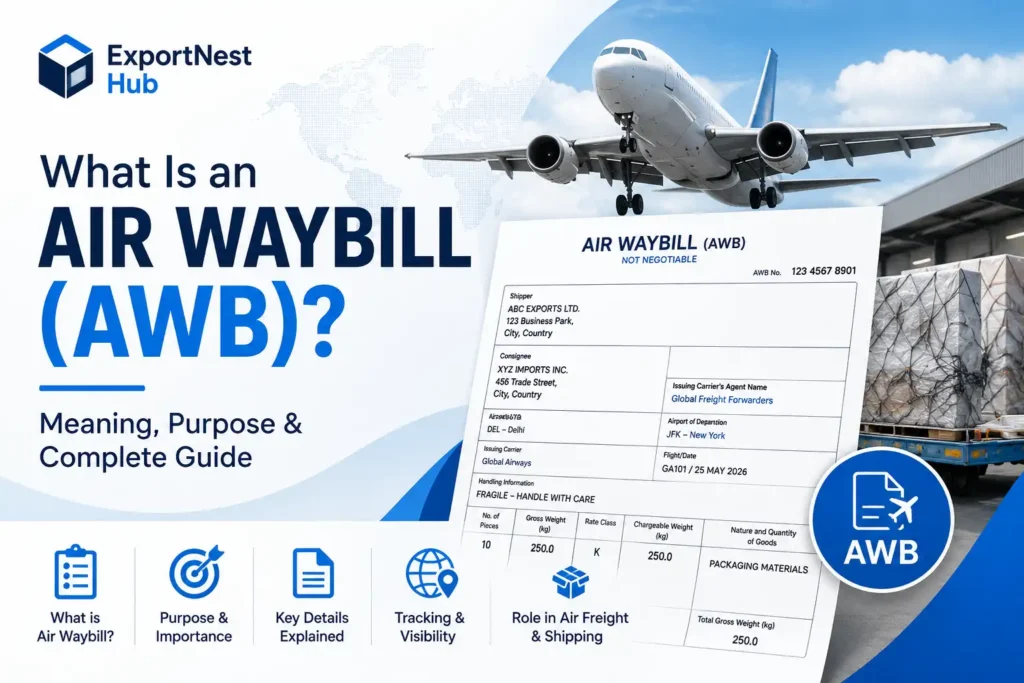
International shipping depends on documents that keep cargo moving in the right direction, through the right channels, with the right details. In sea freight, one of the most important documents is the Bill of Lading. In air freight, the equivalent document is the Air Waybill, commonly called AWB.
If you have searched for air waybill meaning, AWB meaning, or airway bill in shipping, all of these terms point to the same essential document used in air cargo operations. The Air Waybill is a core air freight document that records shipment details, supports cargo movement, helps with tracking, and connects exporters, importers, freight forwarders, airlines, and customs authorities.
This guide explains what an Air Waybill is, why it matters, what information it contains, how it works in shipping, and how it differs from other transport documents. It is designed to help beginners understand the document clearly while also giving businesses and logistics teams a practical overview.
What Is an Air Waybill?
An Air Waybill (AWB) is a shipping document issued for goods transported by air. It works as a receipt for the cargo, a contract of carriage, and a record of shipment details. It is one of the most important documents used in international air cargo movement.
In simple terms, the Air Waybill tells everyone involved in the shipment:
- who is sending the goods
- who is receiving them
- what is being shipped
- where the cargo is going
- how the shipment is moving through the air freight system
Unlike a Bill of Lading in sea freight, an Air Waybill is generally not a document of title. That means it does not usually represent ownership of the goods in the same way some sea shipping documents do. Instead, it mainly serves as evidence of the transport agreement and shipment information.
Because of this, the Air Waybill is especially important in air freight, where speed, accuracy, and visibility matter more than ownership transfer through the transport document itself.
Air Waybill Meaning
The air waybill meaning is straightforward: it is the official air transport document that accompanies goods shipped by air.
The phrase AWB meaning is simply the short form used in logistics, cargo handling, and export documentation. Freight forwarders, airlines, customs teams, and exporters often use AWB as the standard term when discussing air shipments.
A waybill in air freight helps prove that the carrier has accepted the cargo and records the terms under which the shipment is being transported. In that sense, it is one of the most important documents in international air cargo movement.
Why Is an Air Waybill Important?
The Air Waybill is important because it connects the shipment with the air transportation system. Without it, cargo movement becomes harder to track, verify, and process.
Here are the main reasons why this document matters:
1. It proves the cargo has been received
The AWB acts as a receipt showing that the airline or air carrier has accepted the shipment.
2. It defines the transport agreement
It shows the terms under which the goods are being moved, making it a formal air freight document.
3. It supports cargo tracking
The Air Waybill number is used to track the shipment through the air freight process.
4. It helps with customs clearance
Customs authorities may check the AWB along with other shipping documents to verify cargo details.
5. It supports freight coordination
Freight forwarders rely on the AWB to organize pickup, routing, handling, and delivery.
6. It improves shipment visibility
Because the document contains structured shipment information, it helps all parties understand the cargo movement clearly.
For exporters, importers, and logistics teams, the AWB is a key part of the export and air cargo process.
Who Issues an Air Waybill?
An Air Waybill is usually issued by the airline, air carrier, or freight forwarder arranging the shipment.
In many cases, the freight forwarder prepares the document on behalf of the shipper and submits it into the airline’s air freight system. The exact process depends on how the cargo is booked and whether it is moving directly with the airline or through a consolidator.
The document must be accurate because the details are used by multiple parties, including:
- exporter
- importer
- airline
- freight forwarder
- customs authority
- cargo handling staff
Since the AWB supports the entire shipment chain, even small errors can create delays or confusion.
What Information Is Included in an Air Waybill?
A typical Air Waybill contains a range of shipment and transport details. These details help identify the cargo and support its movement.
Common information includes:
- shipper’s name and address
- consignee’s name and address
- airport of departure
- airport of destination
- flight details
- cargo description
- number of packages
- gross weight
- chargeable weight
- freight charges
- declared value
- handling instructions
- AWB number
Because this information is standardized, the AWB becomes a reliable record for the shipment from origin to destination.
In practical shipping operations, this document acts like a central reference point. If the shipment needs to be traced, verified, or matched against other documents, the AWB is usually one of the first documents checked.
What Is an Air Waybill Number?
The air waybill number is the unique reference number assigned to each AWB. It is one of the most important parts of the document because it allows the shipment to be identified and tracked.
This number is usually used to:
- track the shipment online
- locate cargo in the airline system
- match documents with the physical shipment
- reference the cargo during customs or handling
In air freight, the AWB number is like the shipment’s identity card. If someone asks for the current status of the cargo, the first thing they usually need is the Air Waybill number.
For businesses, this number is also useful for customer communication. It helps freight forwarders and exporters give updated shipment information with clarity and confidence.
How Does the Air Waybill Work in Shipping?
The Air Waybill works as the central document in the air freight process. Once the cargo is booked and accepted by the airline or freight forwarder, the AWB is issued. After that, the shipment can move through the air cargo chain.
A typical flow looks like this:
- exporter prepares the goods
- freight forwarder arranges booking
- cargo is handed over to the carrier
- Air Waybill is issued
- cargo moves through the airport network
- shipment is cleared by customs
- goods are delivered to the consignee
This makes the AWB one of the most useful air cargo documents for shipment visibility and control.
In real shipping operations, the AWB may also be used alongside booking confirmations, invoices, packing lists, and customs forms. Together, these documents help keep the movement of goods organized from pickup to final delivery.
Air Waybill vs Bill of Lading
Many beginners confuse an Air Waybill with a Bill of Lading, but they are different documents and belong to different transport modes.
Air Waybill
Used for:
- air freight
- cargo movement by aircraft
- shipment tracking
- transport agreement
- receipt of goods
Bill of Lading
Used for:
- sea freight
- ocean cargo
- vessel shipment
- transport and cargo release
- document of title in some cases
The biggest difference is that an Air Waybill is usually not negotiable and does not function as a title document in the way many sea freight documents can. That is why air cargo relies on different handling rules compared to sea shipping.
In simple terms, the Bill of Lading is central to ocean freight, while the Air Waybill is central to air freight.
Air Waybill vs Commercial Invoice
The Air Waybill is often used together with a commercial invoice, but they serve different purposes.
Air Waybill
Focuses on:
- transport
- shipment movement
- carrier details
- tracking
- cargo handling
Commercial Invoice
Focuses on:
- sale value
- buyer and seller
- product pricing
- customs valuation
- transaction record
Both documents are important in air freight. The commercial invoice tells customs what the goods are worth, while the AWB tells the carrier and logistics teams how the shipment should move.
If the invoice helps define the commercial side of the shipment, the Air Waybill supports the transport side.
Air Waybill vs Packing List
The AWB should also not be confused with a packing list.
Air Waybill
Focuses on:
- shipment routing
- carriage details
- cargo acceptance
- tracking
Packing List
Focuses on:
- package count
- carton details
- weight and dimensions
- contents of each package
The packing list is useful for shipment verification and warehouse handling, while the Air Waybill supports transport and air cargo processing.
Together, these documents give a complete picture of the shipment. The packing list describes the physical packing, while the AWB records the freight movement.
Why Freight Forwarders Care About the Air Waybill
Freight forwarders use the Air Waybill constantly because it is one of the most important documents in air freight operations.
They rely on it to:
- book the shipment
- coordinate cargo movement
- prepare export paperwork
- match cargo with flight details
- support customs documentation
- provide tracking information to clients
In many international shipments, the freight forwarder is the link between the shipper and the airline. The AWB helps keep that link organized and traceable.
Without an accurate AWB, the freight process becomes more complicated. This is why freight teams pay close attention to document accuracy before the cargo is handed over.
Air Waybill and Customs Clearance
Customs authorities may review the Air Waybill during the clearance process. While the AWB itself is not always the only document customs checks, it is part of the larger set of paperwork used to verify the shipment.
Customs may use the document to confirm:
- cargo origin and destination
- shipment description
- package count
- weight information
- carrier and routing details
This makes the Air Waybill an important part of export and import compliance in air cargo movements.
If there is any mismatch between the AWB and other shipping documents, customs clearance may slow down. That is why exporters and freight forwarders should make sure all details match across the entire document set.
Types of Air Waybill
There are different forms and uses of Air Waybills depending on the shipment process. The document may be issued in various operational formats, but the main purpose remains the same: to record and manage the air shipment.
Master Air Waybill
Used when a freight forwarder consolidates multiple shipments under one master booking.
House Air Waybill
Used for individual shipments within a consolidated air cargo movement.
Electronic Air Waybill
A digital version used in modern air cargo systems to reduce paperwork and speed up processing.
These variations are common in air cargo logistics, especially where consolidation and digital documentation are involved.
The exact type of AWB used depends on how the cargo is booked, how it is consolidated, and how the shipment is processed by the carrier or forwarder.
Air Waybill in Export Operations
In export shipping, the AWB is a central document for moving goods by air. It helps exporters and logistics teams keep the shipment organized and reduces confusion during transport.
It is often used for:
- export filing
- shipment booking
- airport handling
- customs processing
- cargo tracking
- delivery coordination
When goods need to move quickly, the Air Waybill becomes especially important because air freight is often chosen for speed and reliability.
For exporters sending urgent, high-value, or time-sensitive goods, the AWB is part of the basic documentation package that makes fast transport possible.
Air Cargo Documents That Work With the AWB
The Air Waybill does not stand alone. It is part of a larger set of air cargo documents used in the shipment process.
Common supporting documents include:
- Commercial Invoice
- Packing List
- Certificate of Origin
- Export declaration
- Customs documents
- Cargo insurance documents if required
Together, these papers help create a full export documentation package for air freight.
A smooth shipment usually depends on how well these documents match each other. When details are consistent across the AWB, invoice, and packing list, the chances of delay become much lower. The Air Waybill is one of several documents commonly used in international trade. See our complete Import Export Documents List.
Common Mistakes With Air Waybills
Many shipping issues happen because of document errors. The same is true for AWBs.
Incorrect shipper or consignee details
Even a small spelling error can cause problems in cargo handling or customs clearance.
Wrong cargo description
The goods should be described clearly and accurately.
Weight mismatch
The gross weight, chargeable weight, and package details should align with the shipment.
Wrong airport information
The origin and destination airports must be correct.
Missing instructions
Special handling requirements should be stated clearly if the shipment needs them.
Avoiding these mistakes can save time and reduce delays. In air freight, where timelines are often tight, document accuracy is especially important.
Why Exporters Should Understand the Air Waybill
Exporters should understand the Air Waybill because it is one of the main documents controlling air cargo movement.
A proper understanding of the document helps exporters:
- prepare correct shipment records
- avoid freight delays
- reduce customs issues
- communicate better with freight forwarders
- track cargo accurately
- keep export documentation organized
If your business ships products internationally by air, knowing how the AWB works is just as important as understanding commercial invoices, packing lists, and customs documentation.
Even if a freight forwarder prepares the document, the exporter should still know what information it contains and why that information matters.
When Is an Air Waybill Prepared?
The Air Waybill is usually prepared after the shipment is booked and before the cargo moves through the air freight process. In most cases, it is created once the carrier or freight forwarder has confirmed the shipment details.
It is usually prepared when:
- goods are ready for dispatch
- booking has been confirmed
- cargo is handed over to the freight forwarder
- flight arrangements are finalized
- air export paperwork is being completed
The sooner the document is correct and finalized, the smoother the shipment process usually becomes.
Timing matters in logistics. If the AWB is delayed or incorrect, the shipment may not move as planned.
Air Waybill and Chargeable Weight
Air freight pricing is often based on chargeable weight, not just actual weight. That is why the AWB is closely connected to freight pricing.
The document often includes:
- actual weight
- volumetric weight
- chargeable weight
This helps the airline or freight forwarder determine the shipping charge correctly. In air freight, lightweight but bulky cargo can cost more than dense cargo because it occupies more cargo space.
That is why the AWB is not just a transport document; it also plays a practical role in freight calculation and pricing. You can estimate air freight charges using our Shipping Cost Calculator.
Air Waybill and Tracking
One of the most useful parts of the AWB is shipment tracking. The Air Waybill number allows the cargo to be traced through the air freight network.
Tracking helps with:
- shipment visibility
- transit monitoring
- delivery planning
- customer communication
- customs follow-up
For businesses that ship regularly, this tracking function is a major advantage.
Customers also expect shipment updates, especially in air freight, where speed and precision are important. The AWB number makes this communication much easier.
Benefits of Understanding Air Waybill Properly
Knowing how the Air Waybill works gives practical benefits for exporters, importers, and logistics professionals.
It helps you:
- understand air freight documentation better
- avoid common shipping mistakes
- coordinate with carriers and forwarders more effectively
- improve shipment visibility
- reduce customs-related confusion
- manage cargo movement with greater confidence
Whether you are running a small export business or managing larger international shipments, understanding the AWB is a useful skill.
Frequently Asked Questions
What is an Air Waybill?
An Air Waybill is a shipping document used for goods transported by air. It acts as a receipt, a transport agreement, and a shipment record.
What is the meaning of AWB?
AWB is the short form of Air Waybill, which is the official air freight document used in air cargo shipments.
Is an Air Waybill the same as a Bill of Lading?
No. An Air Waybill is used for air freight, while a Bill of Lading is used for sea freight.
Is an Air Waybill a document of title?
Usually no. It is mainly a transport document and receipt, not a title document like some sea freight papers.
Why is the Air Waybill number important?
The Air Waybill number is used for tracking and identifying the shipment in the air cargo system.
Who issues the Air Waybill?
It is usually issued by the airline, carrier, or freight forwarder handling the shipment.
Is the Air Waybill required for customs clearance?
It is often part of the customs documentation set used for air freight clearance.
What is the difference between a master AWB and a house AWB?
A master AWB is generally used for consolidated cargo moved by a freight forwarder, while a house AWB is used for individual shipments within that consolidation.
Final Thoughts
The Air Waybill is one of the most important air cargo documents in international trade. It helps record shipment details, support cargo movement, improve tracking, and connect exporters, importers, freight forwarders, airlines, and customs teams.
Whether you are learning the air waybill meaning, searching for AWB meaning, or trying to understand airway bill in shipping, the core idea is simple: the AWB is the document that keeps air freight organized and traceable.
For businesses involved in air shipping, understanding the Air Waybill is essential. It works alongside the commercial invoice, packing list, and other export documents to help shipments move smoothly from origin to destination. Explore more helpful guides like this on ExportNest Hub.