
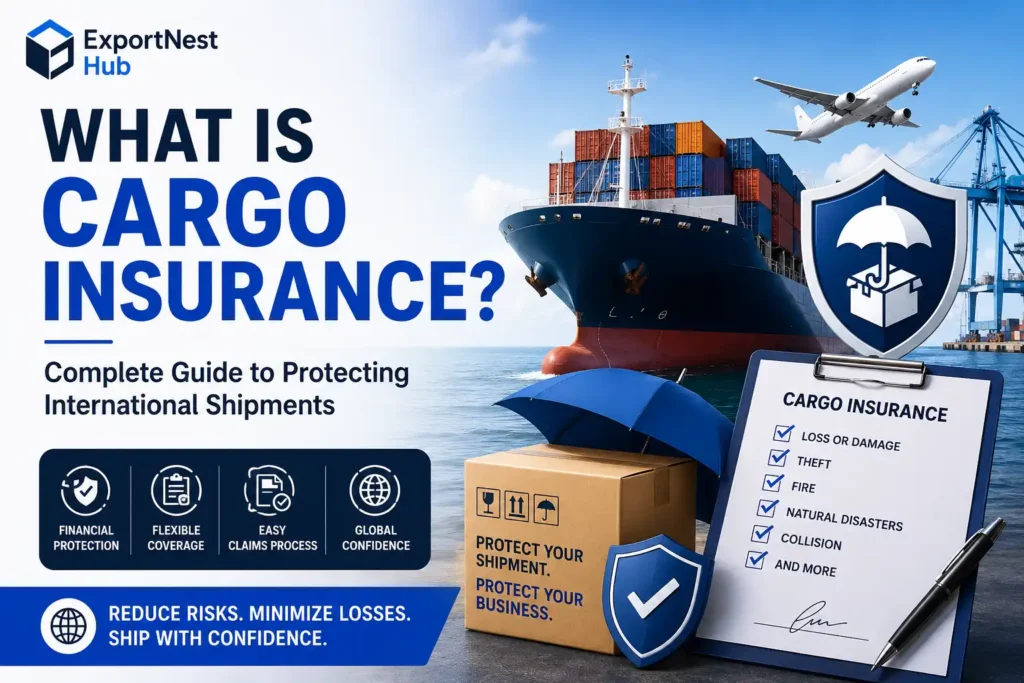
When goods move across borders, they face more risk than many businesses realize. A shipment may be handled by trucks, containers, ports, warehouses, aircraft, or ships before it reaches the buyer. Along the way, cargo can be damaged, lost, stolen, delayed, or affected by weather and handling issues. That is why cargo insurance is such an important part of international trade.
For exporters, importers, freight forwarders, and logistics teams, cargo insurance provides financial protection when something goes wrong during transit. It helps reduce the impact of unexpected losses and gives businesses more confidence when shipping goods internationally.
If you have ever searched for cargo insurance meaning, marine cargo insurance, shipping insurance, or freight insurance, you are already looking at the right topic. These terms are closely related and all point to one main idea: protecting shipments while they are in transit.
This guide explains what cargo insurance is, how it works, what it covers, what it does not cover, how claims work, and how businesses can choose the right cargo insurance policy for international shipments.
What Is Cargo Insurance?
Cargo insurance is a type of insurance that helps protect goods while they are being transported from one place to another. It can cover cargo moving by sea, air, road, rail, or multimodal transport, depending on the policy.
In simple terms, cargo insurance is designed to protect the financial value of your goods if something happens during transit. If the cargo is damaged, lost, or stolen under covered conditions, the insurance may pay for the loss according to the policy terms.
This is why many businesses consider cargo insurance a practical safety measure rather than an optional extra. International shipping involves many moving parts, and not every risk can be controlled by the shipper.
Cargo insurance is especially important for high-value goods, fragile products, perishable items, and large commercial shipments. It is also commonly used in export cargo insurance arrangements where products must travel long distances and pass through multiple handling points.
Cargo Insurance Meaning in Simple Words
The cargo insurance meaning is straightforward: it is insurance that protects the cargo itself during transportation.
It does not insure the business as a whole. It does not automatically cover every possible problem. It is specifically tied to the shipment and the risks that apply while the goods are in transit.
You can think of it as a financial backup for your shipment. If the cargo is harmed by a covered event, the policy may compensate the insured party for the value of the loss.
For businesses involved in global trade, this means greater peace of mind and fewer financial shocks when shipment problems occur.
Why Cargo Insurance Is Important
International shipments face multiple risk points. Cargo may be loaded and unloaded several times, transferred between vehicles, exposed to weather, delayed at ports, or handled by different operators. Even with careful planning, losses can still happen.
Cargo insurance is important because it helps businesses manage that risk. Instead of absorbing the full loss themselves, companies may recover part or all of the shipment value depending on the policy.
Here are some major reasons why cargo insurance matters:
Financial protection
If a shipment is damaged or lost, the cost can be significant. Cargo insurance helps reduce that financial exposure.
Risk management
Shipping is unpredictable. Insurance gives businesses a structured way to manage transit risk.
Better trade confidence
Exporters and importers can ship with greater confidence when they know the goods are protected.
Supports high-value shipments
Expensive, fragile, or sensitive goods often need stronger protection during transit.
Helps small businesses
Smaller exporters may not be able to absorb a major shipment loss. Insurance can reduce that burden.
For many companies, shipping insurance is not only about compliance or formality. It is about protecting cash flow and avoiding major commercial loss.
How Cargo Insurance Works
Cargo insurance works by transferring part of the transit risk to the insurer. The shipper or buyer pays a premium, and the insurer agrees to cover certain losses under the policy conditions.
The general process looks like this:
- The shipper or buyer chooses cargo insurance.
- The cargo details are declared, including value, route, mode of transport, and type of goods.
- A policy or certificate is issued.
- The cargo is shipped.
- If a covered loss occurs, the insured party files a claim.
- The insurer reviews the claim and pays according to the policy if the claim is valid.
The exact process depends on the insurer and the policy type, but the basic idea stays the same: the policy protects the shipment against covered risks during transit.
Cargo Insurance vs Shipping Insurance vs Freight Insurance
Many people use these terms interchangeably, but they are not always identical in practice.
Cargo insurance
This is the broad term for insurance that protects goods in transit.
Shipping insurance
This is often used in a general sense to mean the same thing as cargo insurance, especially in eCommerce or logistics conversations.
Freight insurance
This term is also used commonly, though it may sometimes refer more generally to freight-related protection rather than a formal policy description.
In most business situations, these terms are closely related. However, the exact wording can vary by insurer or transport provider. What matters most is understanding the actual cargo insurance coverage and policy exclusions, not just the label.
Types of Cargo Insurance
Cargo insurance can be structured in different ways depending on the shipment, the route, and the commercial needs of the business.
Single shipment policy
This covers one specific shipment only. It is useful for occasional shippers or one-time cargo movements.
Open policy
This covers multiple shipments over a period of time under one insurance arrangement. Businesses that ship regularly often prefer this because it is more efficient.
Marine cargo insurance
This is one of the most common forms of cargo insurance and is used for shipments moving by sea, although it may also extend to inland legs depending on the policy structure.
Air cargo insurance
This is used for goods moving by air. It is useful for fast, high-value, or time-sensitive shipments.
Multimodal cargo insurance
This covers cargo moving across more than one transport mode, such as truck-to-ship, ship-to-truck, or air plus road.
The right type depends on how often you ship and what kind of cargo you transport.
What Is Marine Cargo Insurance?
Marine cargo insurance is the most widely known form of cargo insurance in international trade. Despite the name, it is not limited only to ocean shipments. It often covers goods moving by sea and may also include inland transportation before departure and after arrival, depending on the policy.
Marine cargo insurance is especially relevant for global trade because sea freight is one of the most common shipping methods for commercial cargo. Containerized goods, bulk goods, and many export shipments use marine transport.
This type of policy is especially useful when goods travel long distances, pass through ports, and are handled multiple times along the route. In that sense, marine cargo insurance is one of the core tools used in international shipping risk management.
What Cargo Insurance Covers
The exact coverage depends on the policy, but cargo insurance often covers risks such as:
- loss during transit
- damage caused by accidents
- theft or pilferage
- fire
- collision
- sinking or overturning
- rough handling
- natural events, depending on policy wording
- water damage under covered conditions
Some policies may also cover loading and unloading risks if those are included in the coverage scope.
The key point is that cargo insurance coverage depends on the policy terms. Not every policy covers every risk, so businesses should always read the wording carefully.
What Cargo Insurance Does Not Cover
Just as important as knowing what is covered is knowing what is not covered.
Cargo insurance often excludes or limits certain risks, such as:
- poor packaging
- inherent product defects
- delay without physical loss or damage
- normal wear and tear
- improper storage before shipment
- fraud or intentional damage
- damage caused by incorrect documentation in some cases
- losses outside the insured transit period
For example, if a shipment is packed poorly and breaks during transport, the insurer may deny the claim because the damage resulted from inadequate packaging rather than an insured transit event.
This is why exporters should not assume that cargo insurance covers everything automatically. The policy must match the real risk profile of the shipment.
Cargo Insurance for Sea Freight
Sea freight is one of the most common areas where cargo insurance is used. Ocean shipments often travel long distances and may be exposed to weather, port handling, and container movement.
For exporters using FCL or LCL shipping, cargo insurance can be especially valuable because cargo may pass through multiple handling points before reaching the final destination. A container can be loaded, moved, stored, transshipped, and unloaded several times before delivery.
In sea freight, marine cargo insurance is often preferred because it can be adapted to the risks of ocean transport. For many businesses, it is a practical way to protect the value of goods moving internationally by container or bulk vessel.
Cargo Insurance for Air Freight
Air freight is usually faster than sea freight, but that does not mean it is risk-free. Air shipments may still be damaged, lost, or delayed due to handling issues, transfer problems, or operational incidents.
Cargo insurance for air freight is often used for:
- high-value products
- time-sensitive shipments
- samples
- electronics
- medical products
- lightweight but expensive goods
Because air freight often moves quickly, businesses may assume the exposure is lower. But the value per shipment can be very high, and a single loss can still be costly. That is why air cargo insurance remains an important part of shipping risk management.
Cargo Insurance and Freight Forwarders
Freight forwarders often help businesses arrange or understand cargo insurance. They may not always issue the policy themselves, but they often play a key role in explaining available options, preparing shipment details, and helping clients decide what level of protection makes sense.
This is especially useful for exporters who are not familiar with insurance policy wording or who are comparing shipping routes. Freight forwarders can help ensure the insurance reflects the cargo type, route, and transport mode.
In many cases, cargo insurance is handled alongside transport planning, documentation, and booking. That makes it a natural part of the freight forwarding process.
How Cargo Insurance Claims Work
If a covered incident happens during transit, the insured party can file a claim. The claim process usually includes:
- notifying the insurer quickly
- gathering shipment documents
- providing evidence of the loss or damage
- showing the cargo value
- submitting photos, reports, or inspection records
- waiting for claim review
- receiving settlement if the claim is approved
The insurer will check whether the event is covered, whether the claim was filed properly, and whether the cargo was insured for that type of route and risk.
A claim is usually stronger when the shipper keeps complete records. That includes invoices, packing lists, transport documents, photos, and proof of damage or loss.
Documents Commonly Needed for Cargo Insurance
When arranging or claiming cargo insurance, you may need documents such as:
- commercial invoice
- packing list
- bill of lading or air waybill
- insurance certificate or policy document
- shipment booking details
- inspection or damage reports
- photos of the cargo or packaging
- correspondence with the carrier if applicable
These documents help establish what was shipped, how much it was worth, and what happened during transit.
Good documentation makes the insurance process smoother and reduces the chance of disputes.
Factors That Affect Cargo Insurance Cost
The cost of cargo insurance depends on several variables. It is not usually a flat rate for every shipment.
Cargo value
Higher-value goods typically cost more to insure.
Type of product
Fragile, perishable, or high-risk cargo may require higher premiums.
Transport mode
Sea freight, air freight, road transport, and multimodal routes may carry different risk levels.
Route and destination
Some routes are considered more complex or higher risk than others.
Coverage level
Broader coverage usually costs more than limited coverage.
Packaging quality
Well-packed goods may be viewed more favorably by insurers.
Shipment frequency
Businesses with regular shipments may choose open policies that work differently from one-off coverage.
Understanding these factors helps businesses compare policies more intelligently.
Do Exporters Need Cargo Insurance?
For many exporters, the answer is yes or at least strongly recommended. The reason is simple: once goods leave the warehouse, the exporter often loses direct control over what happens next.
Cargo can be exposed to handling risks, transport issues, port delays, weather, theft, and accidents. Even a well-run shipment can face problems outside the shipper’s control.
Export cargo insurance is particularly helpful for businesses that ship:
- high-value goods
- fragile products
- perishable items
- regular commercial orders
- shipments over long distances
Even when insurance is not legally required, it may still be one of the smartest risk management decisions a business can make.
Common Cargo Insurance Mistakes
Many businesses make preventable errors when dealing with cargo insurance.
Assuming all risks are covered
Not all policies are broad. Exclusions matter.
Underinsuring the cargo
If the insured value is too low, the claim may not fully cover the loss.
Ignoring packaging quality
Poor packaging can lead to claim problems.
Not reading policy terms
Every cargo insurance policy has details that matter.
Failing to keep documents
Without proper records, the claim process becomes harder.
Choosing the wrong coverage type
A sea shipment may need marine cargo insurance, while an air shipment may need a different structure.
Avoiding these mistakes can save time and money later.
How to Choose the Right Cargo Insurance Policy
Choosing the right policy depends on the cargo and the route. Start by asking:
- What is the cargo value?
- How is it being transported?
- Is the cargo fragile or perishable?
- How often do we ship?
- What are the main risks on this route?
- Does the policy cover the full journey?
The best cargo insurance policy is not necessarily the cheapest one. It is the one that fits the shipment and provides meaningful protection when needed.
A business shipping electronics internationally may need a different policy structure than one shipping bulk industrial materials. Matching coverage to cargo is essential.
Cargo Insurance and International Shipping Terms
Cargo insurance often connects with shipping terms such as Incoterms. The buyer and seller may agree on who is responsible for insurance depending on the term used in the contract.
This is why shipping insurance should be considered together with trade terms, freight documents, and transport responsibilities. If one party assumes the other has arranged insurance, but it was never included, the shipment could be exposed to unnecessary risk.
Understanding the role of insurance within the wider shipping agreement helps avoid confusion and disputes.
Why Cargo Insurance Matters for Business Growth
For growing exporters and importers, cargo insurance is not only a protection tool. It also supports commercial confidence. Businesses are more willing to expand into international markets when they know shipments are financially protected.
That matters because global trade often involves larger order values, more complex logistics, and greater exposure to risk. Cargo insurance helps reduce uncertainty and makes scaling easier.
In that sense, cargo insurance is part of the infrastructure of international business, not just a paperwork detail.
Final Thoughts
Cargo insurance is one of the most important tools for protecting international shipments. Whether you call it cargo insurance, marine cargo insurance, shipping insurance, or freight insurance, the purpose is the same: to help businesses manage loss and damage risk during transit.
For exporters, importers, and logistics teams, understanding cargo insurance meaning, policy coverage, exclusions, and claim procedures is essential. A good policy can reduce financial loss, improve shipment confidence, and support smoother international trade.
Not every shipment needs the same type of coverage, and not every policy covers every risk. That is why businesses should choose insurance based on the cargo, route, value, and transport method involved.
If you are building a reliable shipping operation, cargo insurance should be part of the plan from the start, not something added later after a problem occurs. Explore more helpful guides like this on ExportNest Hub.
Frequently Asked Questions
What is cargo insurance?
Cargo insurance is insurance that protects goods while they are being transported from one place to another.
What does cargo insurance cover?
It may cover damage, loss, theft, fire, collision, and other insured transit risks depending on the policy.
What is marine cargo insurance?
Marine cargo insurance is a common form of cargo insurance used for sea freight and often inland transit related to sea shipments.
Is cargo insurance the same as shipping insurance?
The terms are often used similarly, though the exact wording may vary by insurer or logistics provider.
Do exporters need cargo insurance?
It is strongly recommended for many exporters, especially when shipping valuable, fragile, or high-risk goods internationally.
What documents are needed for a cargo insurance claim?
Common documents include the commercial invoice, packing list, transport document, insurance certificate, and evidence of damage or loss.